Peril of Predictive Analytics in Human Resources

Having spent the past 15+ years in Human Resources technology,  I am generally excited about the things happening with SaaS, Mobile, and Analytics software and technology helping HR bring long awaited strategic value to organizations globally.  However, it is critical that businesses do not out-innovate themselves operationally.   Technology moves at such a rapid pace companies often rush to adopt it out of fear of being left behind without consideration for strategic integration of the technology into the enterprise.  Specifically, users should know what’s happening behind the scenes of the technology they use.  Such is the case for Predictive Analytics and in the domain of HR there are specific moral risks as well as a risk to strategic competition.

I will cover a brief introduction to the terminology of Business Intelligence to clarify the topic covered herein.  A metric, or a fact is a specific data point:

-  turnover % (heads terminated/total [active] heads)

-  revenue per person (total revenue $/total [active] heads)

-  ratio of HR administrators to Employees (total [active] HR employee heads: total [active] heads)

Business Intelligence facts are typically not open to interpretation, but instead fixed and charted over time for different organizational segments.  They can be absolute counts, percentages, ratios, or any other mathematical measure.

Analytics  refer to the mining,  measurement and reporting of facts or metrics (often presented visually) over time as they relate to one another.  Although this realm grows extremely complex in areas such as quantitative risk analysis (often used in financial services) for the purposes of Human Resources we only need to get familiar with some basic concepts:

positive correlation:  in a sample set of data points what % probability will one metric relate to another or move in parallel with another metric forming a ‘//’.

negative or inverse correlation:  in a sample set of data points what % probability will one metric relate to another’s polar opposite, meaning they move in exact opposite directions forming an ‘X’.

For a more detailed intro to HR Analytics read the blog post:  Human Resources Analytics Primer.


Predictive Modeling Errors

I happen to buy mostly business books from Amazon.com most often and for that reason I am presented with quirky recommendations such as “Who Moved My Cheese” courtesy of Amazon’s effective predictive analytics engine.  While some of the recommendations are interesting, others miss the mark completely.  The most frightening result of my shopping habits, as it applies to the Human Resources domain, is that I’ve now found that it will only recommend a very narrow genre of books.  I’ve lost all random and creative associations that used to lead me to surprising new genres and authors.  It has become very Stepford in its associations because the data it leverages is incomplete.

This same Stepford-effect is a risk of predictive analytics in Human Resources.  If I happen to hire a few great performing 20-something-year-old men then that pattern becomes part of the predictive criteria and in turn encourages me to hire more young males.  This is exaggerated to make a point, but it is the same effect witnessed as a result of failing risk models of the subprime mortgage induced market crash (NY Times) and should not be underestimated or dismissed as unrelated.  The full set of data was not possible to obtain or was not considered.  Quantifying and predicting human behavior requires far more data than is possible to obtain with today’s Human Resources software and technology.  This affects many areas of Human Resources but specifically it impacts the more behaviorally nuanced areas such as Talent Analytics: Performance, Recruiting, and Training.

Predictive Analytics are what they “eat” and in Human Resources that amounts to very limited and tightly controlled data today.


Technology Outpacing Operations

Technology also quickly outpaces corporations’ ability to comprehend and effectively train on its usage.  Predictive Analytics reporting especially, due to its complex composition, is not something the average manager is trained to reverse engineer (without great effort) in order to challenge the underlying assumptions.  Therefore, they will typically either be forced to choose to ignore or accept the information at face value.  This is akin to using autopilot without being able to manually fly a plane as well.  As referenced earlier, this is also what afflicted financial services companies who fell victim to the subprime mortgage fallout.  Many people at the top of these firms had very little insight into what sort of details were built into the technical risk models to manage the trading of these instruments.

HR has historically been a far less quantitative business function than other areas such as Finance or Technology.  The lack of insight into these models can erode competitive capabilities very quickly and by the time you begin to lose key resources it may be too late to address the operational causes.


Dehumanizing Human Resources

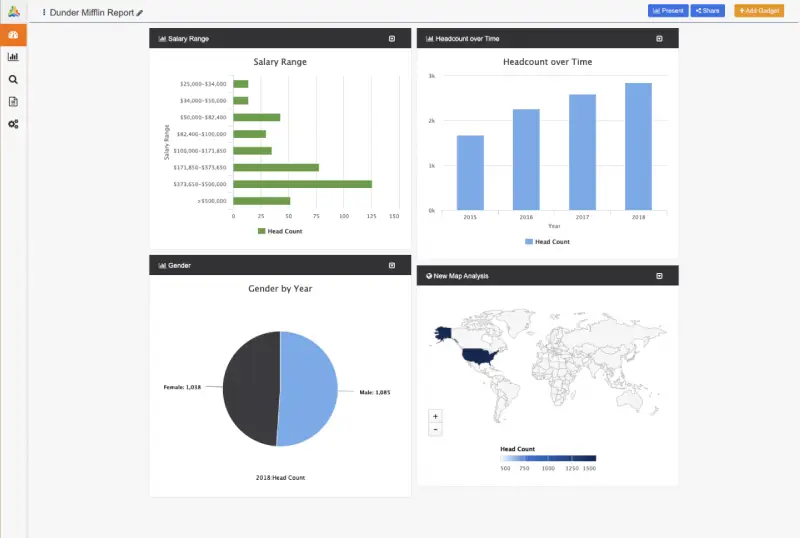
People need shortcuts in the modern day world to cope with the vast amount of data we synthesize every second of every day.  Visual reporting has come a long way and when it is supported by details for further evaluation it is a powerful tool.  However, there is a sinister side to visual reporting and data mining that sometimes (intentionally or unintentionally) can influence business decisions where they should not.

When I was consulting for a client several years ago, there was a request for our team to produce a report to show a “day in the life” of users by name.  We went to great lengths to produce a nicely formatted, visual report allowing managers to see what activities were being completed by which users and when.  We were proud of this user-friendly development until we learned later that it was being used to help justify layoffs.  The tool was neither written to account for many non-system related tasks nor did it by any measure show how productive an employee was in his or her role.  The reality was that Management wanted to dehumanize difficult decisions.  They wanted the job of laying people off to be made less personal and more quantifiable whether it was accurate for this specific purpose or not.

Reporting software vendors are all too willing to oblige and managers all too willing to use the reporting at face value without proper due diligence.  Predictive Analytics in particular in Human Resources is inevitably turned into a “who-to-hire and who-to-fire” tool, a major part of the HR function’s responsibilities and it should not be blindly automated.  While the function of Finance is often to look quantitatively at decision points, HR should offer a counterbalance to this.


Making a Positive Impact

The objective is not to argue that Predictive Analytics cannot be used effectively or responsibly in HR with positive impacts.  There are many beneficial ways Predictive Analytics can be used in HR (among countless others):

  • Determine what new Benefit plans are employees likely to leverage
  • Estimate spikes in Absences or Overtime at certain points during the year
  • Estimate correlated voluntary turnover as a function of involuntary workforce reductions (collateral turnover)
HR needs analytics to earn a lead role in organizational strategy development and execution.  Human Capital Management is difficult to integrate at the executive table without accompanying strategic reporting capabilities.  Many executives do not have HR backgrounds and more often than not they also come from quantitative backgrounds.  Businesses run on numbers.  Therefore HR must follow suit.  However, that does not mean going headlong into Analytics without careful strategic planning and phased execution.


As long as users understand the shortcomings of the data, calculation methods, and support decisions with further tools there is less risk it might be used incorrectly.  HR Administrators, IT professionals,  Executives and software vendors have a responsibility to ensure the implications are thoroughly understood.  Under a wave of pressure on organizations from media, consultancies, and vendors to adopt analytics technology it is critical to not lose sight of the human element of Human Capital Management.

There is a great book that should be mandatory reading for Analytics professionals in general:  Thinking, Fast and Slow by Daniel Kahneman Although its focus is on the mind and its shortcomings in critical thinking, it also covers a lot of the risks alluded to above in data mining and analytics.

Add comment

Comments

  1. ceubanks Reply June 5, 2012 at 4:25 am

    Paul Kearns has some well articulated views on managing HR in the age of Analytics

    http://www.evidencebasedhr.com/

  2. ceubanks Reply June 5, 2012 at 4:36 am

    Morten Kamp provides an insightful look at similar issues with a psychology lens:

    http://mortenkamp.wordpress.com/2012/05/23/cognitive-dissonance-and-hr-analytics-is-a-bad-cocktail/#comments

  3. Mike Reply June 5, 2012 at 4:13 pm

    Interesting read, enjoyed your perspective. However, I’m not sure I agree with is this line: “While the function of Finance is often to look quantitatively at decision points, HR should offer a counterbalance to this.”

    What exactly does it mean to “counterbalance quantitative decision points with HR”?

    Business leaders speak in numbers. Analytics present an incredible opportunity for executives to factor in their workforce in strategic business decision making. The irony that many in HR have missed is quantitative data about the people doing the work actually enables the organization to humanize and better engage its workforce by including their people in business decisions. More information facilitates better business decisions around people – shouldn’t that be a goal?

    The business can use quantitative data to hire, motivate, predict and retain its top performers, facilitating a strategic priority for every business leader focused on performance.

    Suggesting HR provides a “counterbalance” is what HR has always done and goes against the whole value of predictive analytics.

    • ceubanks Reply June 5, 2012 at 5:06 pm

      Mike,

      thanks very much for your comments. I actually agree with everything you’ve said- the last paragraph was meant to cover HR’s urgent need for “Analytics”, but that organizations should be wary of “predictive” functionality in HR.

      However, you’re right, I should clarify my perhaps overly absolute sterotype of the “HR versus Finance” statement… I believe many managers can relate to begging for headcount to handle increased workload and being denied that due to “budget” reasons (especially in the current economy). It is indeed unfair to pit Finance against HR in that sense…the main point there is that Finance has the quantitative date to back up decisions, HR does not. And, in turn, based on your comments, I think we both agree HR needs Analytics to have any meaningful strategic impact.

  4. Martin Collinson Reply June 5, 2012 at 10:08 pm

    A timely note of caution. It wouldn’t surprise me if at some point someone challenges the notion that they shouldn’t be excluded from an interview simply because there is a correlation between their personality profile and performance (let alone their job history, age, gender(!), height, place of birth, qualifications etc).

    The fact that x% of people who did y perform badly at z doesn’t mean Jane Doe will.

    If people are our most important resource, perhaps we ought to respect them enough to assess them on their merit, and on not the artefacts of our modelling?

    • ceubanks Reply June 6, 2012 at 3:17 am

      Martin, appreciate your comments. I hope I have called out what is an exaggerated example of a modeling error, but it is certainly a concern. Even more concerning, eventually you may not know where these types of analytics are applied and how. While HR does need analytics, certain specializations such as predictive analytics should be kept at arm’s length at least until organizations get a better handle on systems, data, and baseline metrics.

      • ceubanks Reply June 6, 2012 at 1:35 pm

        Ironic timing on your post Martin…

        http://online.wsj.com/article/SB10001424052702304821304577436172660988042.html

        There are so many places application of technology can go wrong… the worst fear as stated in my post above is analytics being “turned into a “who-to-hire and who-to-fire” tool.

        While this one article may be a small crack in the facade I do think there are alarming issues under the surface of the frenzied HR analytics software market. I am tempted to apply for a few postings online where I know this is being used to test the theory.

    • ceubanks Reply May 22, 2013 at 9:14 pm

      http://hbr.org/2013/05/3-humans-1-computer-best-prediction/

      Relevant read from Harvard Business Review about predictive analytics that echoes some of the same concerns. A software tool alone isn’t an out of the box solution for this type of advanced analytics.

Add Comment: